


.svg)


 .NET Development
 .NET Support
 CMS
CMS
 Web Development
 Support
 Mobile & IoT
 SVIKA POS


 Manufacturing
 Distribution
 Professional Services
 E-Commerce
 Retail
 Food & Beverages
 Software
 Media & Publishing
Business Challenges
Prior to the NetSuite implementation, client struggled with several operational inefficiencies:
Complex SKU Structure: Each sweet was produced in multiple flavors, pack sizes, and packaging types (box, tin, and pouch), leading to SKU explosion and inventory visibility issues.
Inefficient Production Planning: Manual production scheduling caused frequent ingredient stock outs or overproduction.
Lack of Batch Tracking: No system for batch-wise traceability, critical for quality assurance and compliance.
Disconnected Systems: Finance, inventory, and manufacturing were on disparate tools, creating delays in decision-making and reporting.
Inventory Management Issues: Poor real-time visibility resulted in dead stock accumulation of raw material at stores and other retail locations faced stock outs and lost sales opportunities for Finished Goods.
Supply Chain Inefficiencies: The decentralized and disjointed supply chain created difficulties in balancing stock levels across stores and managing timely replenishments.
Order & Delivery Management: The manual processes involved in managing internal orders and deliveries between manufacturing and retail stores were slow, prone to errors, and costly.
Work Order Management: The absence of a centralized work order management system led to misaligned production schedules, delays in fulfilling orders, and confusion between production and inventory teams.
Lack of Real-Time Operational and Financial Reporting: The Company lacked real-time visibility into operational data (such as inventory levels, sales trends, and production status) and financial reports, making decision-making slow and reactive.
Why Oracle NetSuite
Client chose Oracle NetSuite mainly due to following -
- Unified cloud-based ERP platform.
- Robust Manufacturing, Inventory Management, Supply Chain and Finance modules.
- Scalability for multi-location operations.
- Real-time dashboards and analytics for better decision-making.
- In-built reports for real time analysis

Invitra's Approach
How Invitra Technologies Pvt. Ltd. executed the project
Assessment & Blueprinting
- Conducted detailed business requirement workshops.
- Mapped "As-Is" and designed "To-Be" processes.
Implementation Scope
- Modules Implemented:
- Manufacturing (Light manufacturing, Advanced BOM, Work Order, Outsourced Manufacturing)
- Inventory Management (Demand and supply planning, Multi location inventory, Bin Management, Work in Progress)
- Request for Quotation (RFQ) and Comparative Statement
- Procure-to-Pay
- Order-to-Cash (O2C)
- Finance & Accounting
Customization & Optimization
- Developed custom workflows for purchase order, sales orders and invoice approval process.
- Customized solution implemented for Order fulfillment for ease and faster process.
- Configured dashboards for plant managers & CFO.
- Customized item Barcodes and Incoming inspection process.
Change Management & Training
- Onsite/remote training sessions for end users.
- Continuous support during go-live phase.
- Enhancements
Implementation
To address the challenges and optimize business operations, we implemented a comprehensive NetSuite ERP solution that included the following key modules and features:
- Matrix Items Structure for SKU Simplification: Implemented Matrix Items with item variants based on:
- Flavors
- Pack sizes
- Packaging types (box, tin, and pouch)
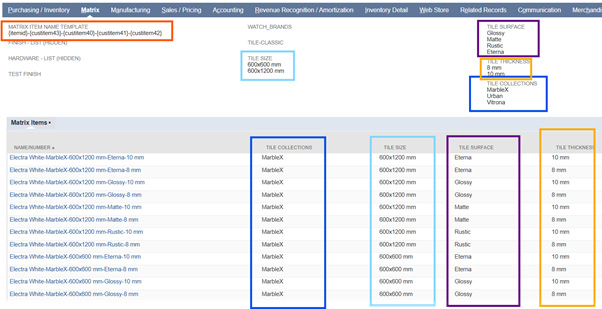
In Tile industry case, you can have a item Matrix with following parameters. For example:
- Tile Collection
- Tile Size
- Tile Surface
- Tile Thickness
- Inventory Management: Real-time, centralized tracking of stock levels across all locations and warehouses, providing accurate and up-to-date insights. This helped reduce excess inventory and improve stock availability.
- Supply Chain Optimization: Integrated supply chain workflows provided end-to-end visibility from procurement through to distribution, optimizing stock levels and minimizing waste.
- Order & Delivery Automation: Automated order processing between retail stores and manufacturing units, ensuring timely and accurate deliveries while reducing manual errors.
- Work Order Management: The NetSuite Manufacturing Module was configured to streamline work order creation, scheduling, and tracking, ensuring production aligned with actual store demand and inventory levels. This improved resource utilization and reduced production delays.
- Procure-to-Pay (P2P): Automation of procurement workflows including purchase requisitions, supplier management, and invoice approvals, ensuring greater efficiency and financial control.
- Order-to-Cash (O2C): Automated the entire sales process from order creation to invoicing and payment, accelerating cash flow and reducing the order-to-cash cycle time.
- Real-Time Visibility: Dashboards and real-time reporting were implemented across all departments, providing instant access to key operational data such as inventory levels, order status, production output, and sales trends.
- Financial Reporting: Integrated financial reports provided executives with a clear view of financial performance, including profit margins, cash flow, and cost of goods sold, ensuring better budgeting and forecasting.
Results Achieved
?
Reduced Dead Stock and Optimized Inventory: Real-time inventory tracking and automated replenishment cycles helped eliminate dead stock and optimize stock levels, reducing waste and freeing up working capital.
?
Faster Order Fulfilment: With automated order management and better communication between stores and the manufacturing unit, order fulfilment became more efficient, timely, and accurate.

Improved Work Order Management: Centralized work order tracking ensured that production schedules were aligned with demand, minimizing delays and improving production planning.
Operational Efficiency: The integration of supply chain, procurement, and manufacturing processes reduced manual effort and improved overall operational efficiency.
Enhanced Financial Visibility: Real-time financial dashboards provided executives with up-to-the-minute insights into key financial metrics, improving decision-making and budgeting accuracy.
Better Decision Making: With customized reports and real-time data, the leadership team gained insights into sales trends, operational bottlenecks, and financial performance, enabling more informed strategic decisions.